goatstuff

>_ cd ops/panoscope && ./demo.sh up

goatstuff

Tools that show what a goat data fabric is doing, and demos that teach it.

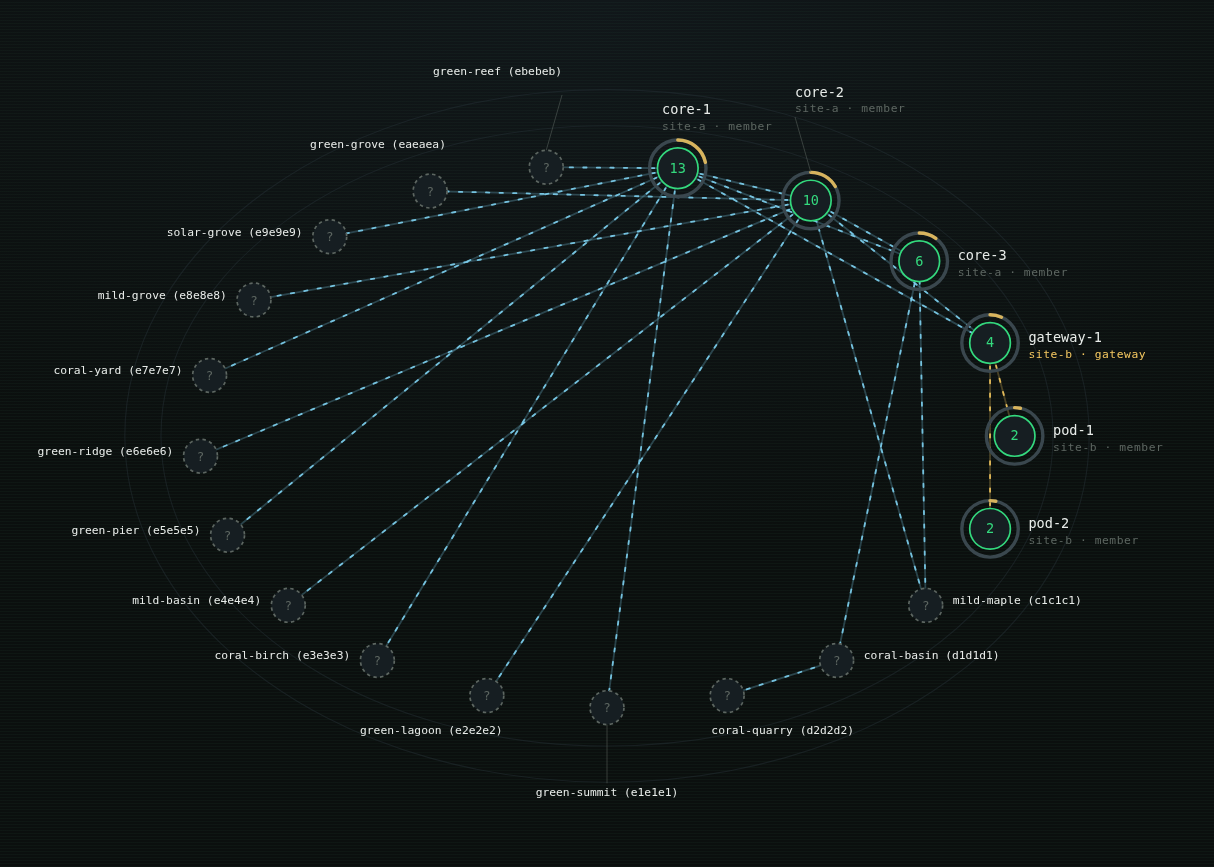
The inspection surfaces, demos and example applications that run beside goatcore. They draw the fabric live, find routers that disagree, grade one topic, let a newcomer publish a message and watch it arrive, and stand in for sensors with synthetic publishers. None of them is needed to run a goatnet.

$ cd ops/serve/zenoh-sandbox/local && ./prep.sh && ./serve.sh

The browser playground on one laptop: a local Zenoh router and the page, no Docker. prep.sh fetches the router once.

panoscope with the synthetic fleet on a local router: the fabric, then one peer and its live stream. Recorded locally.

What it is

goat is a mesh and a Zenoh data fabric for systems that publish and subscribe. goatcore holds the mesh, the fabric, identity, the build tool and the operator CLI. goatstuff holds what you look at and play with on top of it. A surface that deploys has an Ansible role and a playbook under ops/ansible/.

Surfaces that watch the fabric

panoscope draws the whole goatnet, goat-topology draws its routers, flashlight follows one slice, stethoscope grades one target, netvis draws the mesh policy. Rust services in crates/ and ops/, web pages without a build step.

Demos that teach it

A browser playground for publish and subscribe, a zero-trust identity sandbox, an interactive deck on how systems move data, a map, and the gym: lanes of modules, each with a drill. Under ops/serve/ and ops/gym/.

Publishers that feed and test it

Synthetic vendors stand in for sensors, health publishers fill the health surfaces, trashgoat sends unusual traffic on purpose, and transform-shim converts messages between formats. Under ops/zenoh-trial-peers/, ops/goat-trashgoat/ and ops/zenoh-shims/.

Every surface, with what it shows

The status on each card is the one docs/RELEASE-CONTENTS.md gives it. Tested in CI: a workflow builds it and runs its tests on each pull request. Built: a workflow checks that it compiles or parses. Not run: no workflow here runs it.

Watch the fabric

Try it in a browser

Feed it and test it

Publishers put data on the fabric, surfaces read it

Most surfaces only subscribe. goat-topology's page reads what its publishers already put on the bus, so opening it, or refreshing it every second, sends nothing to any router. panoscope is the one surface that queries the fabric when someone asks. Three pieces move data both ways: transform-shim and goat-map republish what they subscribe to, and panoscope's queries get replies.

Publishers on the left put data on the fabric of one goatnet in the middle; surfaces on the right read it. transform-shim, panoscope and goat-map move data both ways.PUT DATA ON THE FABRICREAD ITZenoh routersone goatnet's fabricsynthetic vendorsnotional/**health publishersops/<domain>/health/…trashgoattrashgoat/<slug>/…goat-topology publishops/fabric/topology/<site>/<node>transform-shimone format in, another outpanoscopesubscribes; queries when askedgoat-topology serveops/fabric/topology/**flashlightonly the slice its URL namesstethoscopeone target its URL namesgoat-mapCoT in, GeoTrackV1 out and back Publishers put data on the fabric of one goatnet; surfaces read it. transform-shim, panoscope and goat-map, marked with a double arrow, move data both ways.PUT DATA ON THE FABRICsynthetic vendorsnotional/**health publishersops/<domain>/health/…trashgoattrashgoat/<slug>/…goat-topology publishops/fabric/topology/<site>/<node>transform-shim ⇅one format in, another outboth waysZenoh routersone goatnet's fabricboth waysREAD ITpanoscope ⇅subscribes; queries when askedgoat-topology serveops/fabric/topology/**flashlightonly the slice its URL namesstethoscopeone target its URL namesgoat-map ⇅CoT in, GeoTrackV1 out and back
A dashed arrow is the return direction of a flow that goes both ways. Key expressions are the ones each component's code or README uses. The browser playground is not on the figure: it talks to its own throwaway router.

The playground runs on one laptop

The browser playground is two pieces: the static page in ops/serve/zenoh-sandbox/app/ and a local Zenoh router with the remote API WebSocket plugin. prep.sh fetches the router for your machine once; after that serve.sh needs no internet and no Docker. Click Connect, start the pretend sensor, listen on demo/**.

cd ops/serve/zenoh-sandbox/local
./prep.sh      # once, needs internet
./serve.sh     # page on :8080, router on ws://localhost:10000

What the subscriber on demo/** heard in the recording:

demo/sensor/fahrenheit  {"fahrenheit":64.54}demo/sensor/temp        {"celsius": 18.08}demo/sensor/fahrenheit  {"fahrenheit":65.84}demo/sensor/temp        {"celsius": 18.80}
Recorded in headless Chrome against the local router: Listen, then the sensor, then the transform, then two one-off publishes on demo/hello.

Quick start

Clone the repository, then pick one.

git clone https://github.com/USAREUR-AF/goatstuff
cd goatstuff

The playground

cd ops/serve/zenoh-sandbox/local
./prep.sh && ./serve.sh

Python 3 and one download of the router. Then open http://localhost:8080.

panoscope with synthetic peers

cd ops/panoscope
./demo.sh up

Docker. Then open http://127.0.0.1:8080. The first build compiles panoscope and the data generator and takes 15 to 20 minutes; later starts take seconds. README-local-demo.md

Every Rust surface

cd crates
cargo build --release
cargo test --workspace

Rust. crates/Cargo.toml fetches panoscope-core from goatcore by tag.

README · Release contents · Contributing · goat as one system