goat

goat

A self-hosted data fabric that keeps working when the network around it fails.

goat joins people, machines and services across sites into one network. They publish and subscribe to data, and access is decided by who they are, not where they sit. A device that has joined keeps talking to its peers directly, with or without the cloud.

Star on GitHub First hour Docs

$ git clone https://github.com/usareur-af/goatcore && cd goatcore

Open source · Apache-2.0 · pre-1.0

Two sites joined by a direct tunnel keep exchanging messages while their link to the cloud is cut Cloud Relays DNS name enroll and relay Site alpha goatcore Site bravo goatcore direct tunnel cloud link: up alpha → bravo seq 12 {"msg": "hello from the laptop"}
A drawing of the mechanism, animated. Messages keep crossing the direct tunnel while the cloud link is cut. The message is the payload published in the panoscope recording further down.
  • 0.05 sto rehearse a full standup of the example environment on a laptop: 5 components on 4 machines, 14 checks
  • 331error codes, each with what happened, why, and what to do; goat explain reads them offline
  • 377decision records in the repository, one per design decision, never rewritten
  • 20.7 MBthe largest goatbuilder release binary; one file per platform, four platforms

Every figure is reproduced with a command in Numbers.

What uses the data, and what shares it with partners Operations one shared picture goatstuff live views Analytics and AI agents Boundary node to a partner goatnet One data fabric: publish and subscribe by identity, no central broker goatcore site alpha goatcore site bravo goatcore site charlie tunnel tunnel Cloud relays enroll and relay A modern system joins NetBird client goat-client: forthcoming One system, integrated once open-billie integrates one system A network, bridged octo-pod a pod across networks or via a pod sensors effectors C2 systems servers laptops phones an old or proprietary system an existing tactical network system system system system Built and run with two command-line tools goatbuilder builds, releases and deploys every site goat operates a goatnet: health, access, data
How systems join a goat deployment and what is built around it. A modern system, such as a sensor, an effector, a C2 system, a server, a laptop or a phone, joins directly with the NetBird client; goat-client is a forthcoming option. open-billie integrates one old or proprietary system once, onto the fabric or through a local pod. octo-pod is itself a pod across networks, most often bridging an existing tactical network; data goes both ways through it. Either one can connect any kind of system. Each site runs its own goatcore, and the sites share one data fabric. The systems that use the data publish and subscribe on it by identity; a boundary node releases chosen data to a partner's own goatnet. goatbuilder builds, releases and deploys every site, and goat operates the goatnet. Relays and one public DNS name in the cloud are used when a device enrolls and when two peers cannot reach each other directly; peers that have joined keep their tunnels when the cloud cannot be reached. A diagram, not a capture. Select a part to read about its repository. The figure scrolls sideways.

What it is

One network across sites. No central broker. Access by identity.

goat is an integration of established open-source projects, assembled and operated as one system. A goatnet is one environment: its own mesh, identity service, certificate authority and data fabric. Two command-line tools come with it: goatbuilder builds, releases and deploys a goatnet, and goat operates one.

Nothing sensitive faces the internet

Every service listens only inside the encrypted network. The public internet sees DNS records, not open ports.

Joined devices keep working when the center goes down

The management service is needed to enroll a device, not to keep it connected. If it fails, peers carry on talking to each other.

There is no central data broker to lose

Data moves between publishers and subscribers directly, so no single server stands between them.

ConcernBuilt on
NetworkWireGuard peer-to-peer tunnels, managed by NetBird, with relays for peers that cannot reach each other directly
DataEclipse Zenoh publish/subscribe with no central broker
IdentityOry for people and services, SPIFFE for workloads, an offline certificate authority for machines
Site statePostgreSQL, replicated active-active between sites

Source: the goatcore README. The full list with licenses: the projects goat is built with.

The parts

Five repositories, one system.

goatcore is the substrate. goatstuff looks at it. open-billie and octo-pod bring data onto it from equipment that is not goat. goatdocs explains it. Only goatcore is needed to run a goatnet.

goatcore

The substrate

The code that builds and runs a goatnet: the mesh control plane, the Zenoh data fabric, identity, the goat and goatbuilder command-line tools, and the Ansible roles and Terraform modules that deploy them. Machines pull their configuration and report what they run; a deployment is finished when every report matches the declaration.

Start

$ git clone https://github.com/usareur-af/goatcore && cd goatcore

Real output of goatbuilder status, release 0.7.3, after the rehearsal in First hour. zagros is the example goatnet in the repository. The output scrolls sideways.
goatstuff

Inspection and demos

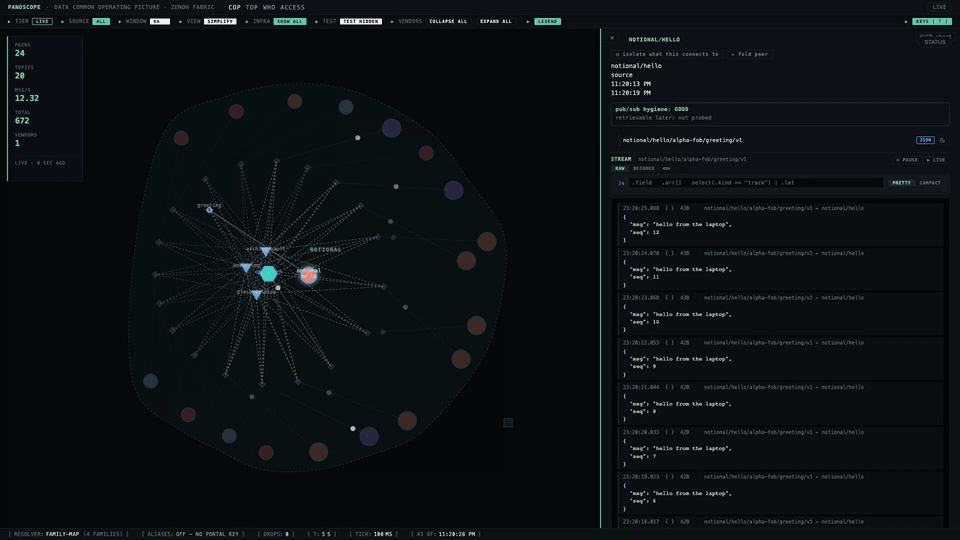
Inspection tools and demonstration applications that run on a goat data fabric: panoscope (the whole goatnet at a glance), stethoscope (health), flashlight (who did what, when), netvis (the mesh access rules as a picture), and example applications. None of it is needed to run a goatnet.

panoscope showing 24 synthetic peers and 20 topics on a local Zenoh fabric as a graph, with the live stream of a newly published greeting topic on the right

One frame of a real capture: panoscope on a laptop with synthetic data. The full recording is in goatcore.

Build every surface

$ cd crates && cargo build --release

goatdocs

The explanation

Architecture, strategy, the design system, reference tables and integration guides, published as this documentation site. It also serves one page per error code of goat and goatbuilder, generated from goatcore's error catalog. Every document states what is built, designed or not built.

usareur-af.github.io/goatdocs/reference/errors/GB-001/
The documentation page for error code GB-001, unknown component, with sections What it means, Why it happens and What to do

A real capture of this site: the page for error code GB-001.

Preview the site

$ pip install -r .github/pages/requirements.txt && mkdocs serve

open-billie

Sensor node
1 Sensor TCP or UDP 2 Kid package decode, map 3 Translator encode 4 Local Zenoh route 5 Fabric mTLS bridge

The data path, from the open-billie README. A diagram, not a capture. The figure scrolls sideways.

A sensor-neutral platform for one node beside a sensor. A kid package holds one sensor's decoder, schema and mapping; the shared translator turns its records into Cursor-on-Target, ASTERIX CAT062 or SAPIENT and publishes them through Zenoh. The platform owns the fabric credentials, so a kid package needs none.

Start the guided setup

$ bash tools/setup.sh

Real output of the offline scan on the public example package, which uses synthetic data. The checkout path is shortened. The output scrolls sideways.

octo-pod

Edge gateway
Local network sensors and receivers UDP, TCP, Zenoh octo-pod capture and audit stay local Fabric released feeds out, chosen data in ingress release deliver to a receiver

What crosses, both ways, from the octo-pod README. A diagram, not a capture. The figure scrolls sideways.

An edge gateway appliance on one small computer where sensors live. It takes in their feeds, records and audits them locally, and releases only what you choose onto the fabric. It works the other way too: it delivers data from the fabric to a local receiver. Every feed gets its own certificate and a narrow set of keys. Nothing on the running pod changes until you apply.

Install release 0.6.0 from your laptop

$ tools/install-to-pod.sh operator@192.0.2.10 --version 0.6.0 --with-images

Real output: the first lines of octo-pod --help. The output scrolls sideways.

First hour

Rehearse on your laptop, then stand up one machine.

This is the path the goatcore README and its first tutorial give. The rehearsal touches no network. The tutorial says the real run takes an hour or more and asks you not to plan around a number.

  1. Get the code and the builder

    Clone goatcore and download goatbuilder for Linux or macOS. Each release lists a SHA-256 checksum per binary, signed with cosign.

    git clone https://github.com/usareur-af/goatcore && cd goatcore
    OS="$(uname -s | tr '[:upper:]' '[:lower:]')"; ARCH="$(uname -m | sed 's/x86_64/amd64/; s/aarch64/arm64/')"
    curl -fsSL -o goatbuilder "https://github.com/usareur-af/goatcore/releases/download/goatbuilder/v0.7.3/goatbuilder-$OS-$ARCH"
    chmod +x goatbuilder
  2. Rehearse a complete standup

    goatbuilder stands up the example goatnet zagros against a simulated set of machines: one site with two core machines, one monitoring machine and one recovery machine.

    WORK="$(mktemp -d)/zagros"
    cp -R ops/goatbuilder/fixtures/goatnet-from-scratch/01-founder "$WORK"
    ./goatbuilder standup zagros --site alpha --mock "$WORK" --ack "you" --yes
    ./goatbuilder status --env zagros --mock "$WORK"

    Real output of the standup line, release 0.7.3, shortened where marked. The output scrolls sideways.

  3. Stand up goatlite on one machine

    goatlite is a goatnet on one Ubuntu 24.04 host or virtual machine with 4 cores and 16 GB, with no outside account. You write one file of four facts (a name, the host, the SSH user, the administrator), check your laptop with the doctor, and run one command. It is for learning and first goatnets, not for production.

    goatbuilder doctor
    goatbuilder standup pasture

    Tutorial 0: your first goatnet explains each step. You finish by publishing a message and receiving it.

  4. Carry on

    A new environment on real hardware, a second site, and sharing with a partner. When a command fails, paste its output into goat explain.

    Real output of goatbuilder explain GB-001. The output scrolls sideways.

Numbers

Each number, and the command behind it.

WhatNumberHow to check it
Rehearsal standup of the example environment0.05 sTime the standup line in step 2. Six runs of release 0.7.3 on an Apple M3 laptop took 0.048 to 0.057 s.
What the rehearsal verifies5 on 4, 14 checksThe last two lines of that command's output: 5 components on 4 machines.
goatbuilder release binary17.8 to 20.7 MBAsset sizes of release goatbuilder/v0.7.3: Linux and macOS, amd64 and arm64.
Error codes with what, why and fix331grep -c '^ - code:' ops/errors/catalog.yaml in goatcore
Decision records377ls docs/adr | grep -c '^[0-9]' in goatcore
CI checks you can run locally160ls ops/ci | grep -c '^check-' in goatcore
Phases in every standup14Tutorial 0 and the standup runbook in goatcore
Output formats from one open-billie mapping3bash deploy/bin/billie kid scan kids/examples in open-billie
Kinds of octo-pod arm4 in, 6 outThe Functions section of the octo-pod README

Counts were taken on main of goatcore at commit f2f1586, open-billie at a94cb4c and octo-pod at fe48297. They grow; run the command for the current value.

Take part

Build on the stable line. Contribute to main.

goat is pre-1.0: interfaces can still change between releases.

Build on it

Use the stable branch of goatcore or the goatcore/v tag it points at. How the two lines fit together.

Change it

Open a pull request against main. Read CONTRIBUTING first; every CI check is a script under ops/ci/ that you can run locally.

List what you built

Work that other people and organizations build on goat is listed in awesome-goat. Add yours there.

Report a vulnerability

Privately, as described in SECURITY. Not in a public issue.