
goat-transformers
Any message format to any other. Every format is a data file.
A drone's 25-byte Remote ID broadcast becomes a Cursor on Target event for a tactical map. No engine holds code for either format: each is a pack, a text file with one line for each field, and seven engines in seven languages read the same packs and must agree byte for byte.
Star on GitHub Run it in this page Docs Install
git clone https://github.com/USAREUR-AF/goat-transformers
cd goat-transformers/engines/rust
cargo build --release
when 0:4:4 1byte 0, high half: 1kind locationfield lat 0:40:32 sscale:1/10000000bytes 5–8: 455393090lat 45.539309field lon 0:72:32 sscale:1/10000000bytes 9–12: -1229663890lon -122.966389field hae 0:120:16 uscale:1/2:-1000 absent 0bytes 15–16: 2220hae 110default type a-u-X, ce 9999999, le 9999999from the cot-xml packnot known
<event version="2.0" type="a-u-X"><point
  lat="45.539309" lon="-122.966389"
  hae="110" ce="9999999" le="9999999"/><detail/></event>
The catalog
4,255 formats in 234 families, one shared model
How to read it
- Center: the shared model. Every format converts through it.
- Colored ring: the domain. Segment width is not a count.
- Each bar: one format family. Longer means more formats (log scale; faint rings at 1, 10 and 100).
- Dashed ring: where private formats plug in.
- Air 6 families, 38 packsASTERIX 30, ADS-B 2, OpenSky Network REST API 2
- Land vehicles 17 families, 570 packsOCPP 2.0.1 128, Waymo Open Dataset 114, CAN DBC (opendbc) 91
- Sea 14 families, 29 packsArgo floats (GDAC index, metadata JSON) 5, Maritime routes and NMEA extras (RTZ, TAG block, PUBX, AIS area notice) 4, NGA Maritime Safety Information 4
- Space 9 families, 365 packsSpace Data Standards 298, NASA GCN notices 21, CCSDS frames and packets 15
- Uncrewed systems and robots 18 families, 1,640 packsArduPilot DataFlash log 342, PX4 ULog 301, Cyphal (UAVCAN v1) 250
- C2 and tactical 11 families, 14 packsCursor on Target 2, goat-processors outputs 2, UCI 2
- Sensors 25 families, 159 packsNITF 2.1 32, SBP (Swift Navigation) 22, RoboSense lidar 19
- Transport 19 families, 229 packsGBFS 84, Eclipse SUMO traffic simulation files 41, GTFS Schedule 31
- IoT 27 families, 510 packsESPHome native API 143, SunSpec Modbus 112, FIWARE Smart Data Models 93
- Networks 49 families, 487 packsHL7 FHIR R4 146, OCSF 79, IETF packet headers 40
- Maps, weather and alerts 39 families, 214 packsOGC API 42, NWS weather.gov API 31, aviationweather.gov Data API 23
Every family as a table
| Domain | Family | Packs |
|---|---|---|
| Air | ASTERIX | 30 |
| Air | ADS-B | 2 |
| Air | OpenSky Network REST API | 2 |
| Air | readsb JSON | 2 |
| Air | GDL 90 | 1 |
| Air | UAT 978 MHz ADS-B | 1 |
| Land vehicles | OCPP 2.0.1 | 128 |
| Land vehicles | Waymo Open Dataset | 114 |
| Land vehicles | CAN DBC (opendbc) | 91 |
| Land vehicles | OCPP 1.6 | 78 |
| Land vehicles | Baidu Apollo | 48 |
| Land vehicles | Eclipse uProtocol | 33 |
| Land vehicles | AgGateway ADAPT | 22 |
| Land vehicles | Tier IV (ROS 2) | 13 |
| Land vehicles | ASAM OSI (Open Simulation Interface) | 12 |
| Land vehicles | Autoware (ROS 2) | 11 |
| Land vehicles | Eclipse KUKSA.val | 8 |
| Land vehicles | Tesla Fleet Telemetry | 5 |
| Land vehicles | Vehicle diagnostics (ISO-TP, UDS, DoIP) | 3 |
| Land vehicles | AgOpenGPS | 1 |
| Land vehicles | COVESA VSS | 1 |
| Land vehicles | OpenXC | 1 |
| Land vehicles | SAE J1939 frames | 1 |
| Sea | Argo floats (GDAC index, metadata JSON) | 5 |
| Sea | Maritime routes and NMEA extras (RTZ, TAG block, PUBX, AIS area notice) | 4 |
| Sea | NGA Maritime Safety Information | 4 |
| Sea | Signal K | 3 |
| Sea | AIS | 2 |
| Sea | ERDDAP tabledap | 2 |
| Sea | NMEA 2000 | 2 |
| Sea | AIS binary applications of variable length | 1 |
| Sea | AIS regional binary messages (St. Lawrence Seaway, USCG PAWSS) | 1 |
| Sea | aisstream.io | 1 |
| Sea | IOOS glider DAC | 1 |
| Sea | NDBC realtime2 buoy data | 1 |
| Sea | NMEA 0183 | 1 |
| Sea | Raymarine SeaTalk 1 | 1 |
| Space | Space Data Standards | 298 |
| Space | NASA GCN notices | 21 |
| Space | CCSDS frames and packets | 15 |
| Space | NASA DONKI | 11 |
| Space | NASA cFE | 10 |
| Space | NASA NeoWs | 4 |
| Space | CelesTrak GP data and TLE | 3 |
| Space | CubeSat Space Protocol | 2 |
| Space | CCSDS NDM/XML | 1 |
| Uncrewed systems and robots | ArduPilot DataFlash log | 342 |
| Uncrewed systems and robots | PX4 ULog | 301 |
| Uncrewed systems and robots | Cyphal (UAVCAN v1) | 250 |
| Uncrewed systems and robots | Gazebo messages (gz-msgs) | 219 |
| Uncrewed systems and robots | DroneCAN (UAVCAN v0) | 133 |
| Uncrewed systems and robots | MAVSDK (gRPC protobuf) | 113 |
| Uncrewed systems and robots | ROS 2 interface packages | 62 |
| Uncrewed systems and robots | Foxglove | 48 |
| Uncrewed systems and robots | UTM APIs (ASTM F3411 network RID, F3548) | 46 |
| Uncrewed systems and robots | Parrot ARSDK | 44 |
| Uncrewed systems and robots | Parrot ARSDK protobuf | 39 |
| Uncrewed systems and robots | MAVLink 2 | 14 |
| Uncrewed systems and robots | Open-RMF (ROS 2) | 13 |
| Uncrewed systems and robots | VDA 5050 mobile robot interface | 8 |
| Uncrewed systems and robots | RC and small-UAS telemetry | 4 |
| Uncrewed systems and robots | Remote ID (ASTM F3411) | 2 |
| Uncrewed systems and robots | DRIP (RFC 9575) | 1 |
| Uncrewed systems and robots | MassRobotics AMR interoperability | 1 |
| C2 and tactical | Cursor on Target | 2 |
| C2 and tactical | goat-processors outputs | 2 |
| C2 and tactical | UCI | 2 |
| C2 and tactical | A-GRA | 1 |
| C2 and tactical | APRS | 1 |
| C2 and tactical | C2SIM | 1 |
| C2 and tactical | Canonical Track v2 | 1 |
| C2 and tactical | DIS (IEEE 1278.1) | 1 |
| C2 and tactical | GeoTrackV1 | 1 |
| C2 and tactical | NVG | 1 |
| C2 and tactical | STANAG 4676 ISR tracking | 1 |
| Sensors | NITF 2.1 | 32 |
| Sensors | SBP (Swift Navigation) | 22 |
| Sensors | RoboSense lidar | 19 |
| Sensors | Septentrio SBF | 17 |
| Sensors | u-blox UBX | 14 |
| Sensors | Inertial Sense | 10 |
| Sensors | Ouster lidar | 9 |
| Sensors | GNSS correction transport and network timing (NTRIP, NTP/NTS, PTP) | 4 |
| Sensors | ISA | 4 |
| Sensors | MISB local sets | 4 |
| Sensors | STANAG 4607 GMTI | 4 |
| Sensors | GNSS receiver binary (NovAtel OEM, SiRF) | 2 |
| Sensors | OGC SensorThings | 2 |
| Sensors | OGC SWE | 2 |
| Sensors | RINEX (GNSS observation and navigation files) | 2 |
| Sensors | SAPIENT | 2 |
| Sensors | Velodyne lidar | 2 |
| Sensors | gpsd JSON | 1 |
| Sensors | IGS SSR | 1 |
| Sensors | Livox SDK2 | 1 |
| Sensors | OGC Moving Features JSON | 1 |
| Sensors | OGC O&M Simple Features | 1 |
| Sensors | RTCM 3 | 1 |
| Sensors | SBAS L1 messages | 1 |
| Sensors | Unicore UNI | 1 |
| Transport | GBFS | 84 |
| Transport | Eclipse SUMO traffic simulation files | 41 |
| Transport | GTFS Schedule | 31 |
| Transport | OCPI | 17 |
| Transport | WZDx | 10 |
| Transport | Curb Data Specification | 8 |
| Transport | GOFS | 8 |
| Transport | TOMP-API | 7 |
| Transport | OSDM (railways) | 5 |
| Transport | NeTEx | 4 |
| Transport | ERTMS/ETCS (SUBSET-026) | 3 |
| Transport | GTFS Realtime | 2 |
| Transport | hafas-client | 2 |
| Transport | OpenTripPlanner GraphQL | 2 |
| Transport | ETSI ITS | 1 |
| Transport | GS1 EPCIS 2.0 events | 1 |
| Transport | MDS | 1 |
| Transport | TransXChange | 1 |
| Transport | Valhalla | 1 |
| IoT | ESPHome native API | 143 |
| IoT | SunSpec Modbus | 112 |
| IoT | FIWARE Smart Data Models | 93 |
| IoT | EVerest charging stack | 55 |
| IoT | ChirpStack v4 | 31 |
| IoT | Meshtastic | 12 |
| IoT | OpenADR 3 | 7 |
| IoT | Zigbee Cluster Library (zigbee-herdsman) | 7 |
| IoT | KNX | 6 |
| IoT | IEEE C37.118 synchrophasor (pypmu) | 5 |
| IoT | Modbus | 4 |
| IoT | Shelly Gen2+ RPC | 4 |
| IoT | BACnet/IP, EtherNet/IP and HART-IP framing | 3 |
| IoT | Metering (M-Bus, wireless M-Bus, DLMS HDLC) | 3 |
| IoT | OPC UA binary (NodeSet structures) | 3 |
| IoT | Tasmota | 3 |
| IoT | The Things Stack | 3 |
| IoT | BLE beacons | 2 |
| IoT | Home Assistant | 2 |
| IoT | LoRaWAN framing (PHYPayload, Semtech UDP forwarder) | 2 |
| IoT | Low-power mesh (6LoWPAN, RPL) | 2 |
| IoT | OpenMQTTGateway | 2 |
| IoT | Smart-home serial framing (Z-Wave Serial API, EnOcean ESP3) | 2 |
| IoT | DSMR P1 (Dutch smart meters) | 1 |
| IoT | OMA LwM2M | 1 |
| IoT | SML (Smart Message Language) | 1 |
| IoT | Sparkplug B | 1 |
| Networks | HL7 FHIR R4 | 146 |
| Networks | OCSF | 79 |
| Networks | IETF packet headers | 40 |
| Networks | STIX 2.1 | 39 |
| Networks | OpenConfig (RFC 7951 JSON) | 24 |
| Networks | IETF YANG data (RFC 7951 JSON) | 19 |
| Networks | Tunnelling and VPN (VXLAN-GPE, Geneve options, MPLS stack, IKEv2) | 14 |
| Networks | OpenTelemetry OTLP | 12 |
| Networks | Zeek JSON logs (scope separator _) | 9 |
| Networks | gNMI | 8 |
| Networks | IPPM active measurement (OWAMP, TWAMP, STAMP) | 8 |
| Networks | IP flow export (IPFIX, NetFlow, sFlow) | 7 |
| Networks | Media transport (MPEG-TS, SRT, RIST, WebRTC DCEP, RTP) | 6 |
| Networks | Amateur digital voice and data (M17, D-STAR, DMR) | 5 |
| Networks | Directory and naming (NetBIOS name and datagram services, LLMNR, SLPv2) | 4 |
| Networks | Messaging protocols (MQTT, AMQP 1.0, STUN/TURN) | 4 |
| Networks | Printing (IPP binary encoding, LPD) | 4 |
| Networks | Web transport framing (HTTP/2, HTTP/3, WebSocket, TLS 1.3) | 4 |
| Networks | 3GPP mobile core (GTP-U, GTPv2-C, PFCP) | 3 |
| Networks | Amateur and paging radio (AX.25, KISS, POCSAG) | 3 |
| Networks | Finance messages (FIX tag=value, QIF, OFX transactions) | 3 |
| Networks | Internet control plane (DNS message, DHCPv6 message, ICMPv6 ND) | 3 |
| Networks | QUIC (long-header packets, frames, transport parameters) | 3 |
| Networks | Remote access and file sharing (SSH, SMB2/3) | 3 |
| Networks | Routing control protocols (BMP, BFD, RPKI to Router) | 3 |
| Networks | Bibliographic records (MARC 21, CSL-JSON) | 2 |
| Networks | CISA KEV catalog | 2 |
| Networks | Health data (HL7 v2 segments, DICOM files) | 2 |
| Networks | IETF option areas | 2 |
| Networks | ISO transport over TCP and RDP connection negotiation (TPKT/X.224, RDP_NEG) | 2 |
| Networks | OpAMP | 2 |
| Networks | OpenC2 | 2 |
| Networks | Prometheus remote write | 2 |
| Networks | Security event logs | 2 |
| Networks | Signalling transport (Diameter, SCTP) | 2 |
| Networks | BGP MRT | 1 |
| Networks | CACAO playbooks | 1 |
| Networks | CloudEvents | 1 |
| Networks | COSE | 1 |
| Networks | CVE JSON record | 1 |
| Networks | DTN Bundle Protocol 7 | 1 |
| Networks | Elastic Common Schema | 1 |
| Networks | HSRP | 1 |
| Networks | MISP core format | 1 |
| Networks | OpenIOC 1.1 | 1 |
| Networks | OSV vulnerability entry | 1 |
| Networks | PCEP | 1 |
| Networks | Suricata EVE JSON | 1 |
| Networks | Wi-Fi beacon frame | 1 |
| Maps, weather and alerts | OGC API | 42 |
| Maps, weather and alerts | NWS weather.gov API | 31 |
| Maps, weather and alerts | aviationweather.gov Data API | 23 |
| Maps, weather and alerts | OGC JSON encodings | 15 |
| Maps, weather and alerts | OpenAQ API | 15 |
| Maps, weather and alerts | Overture Maps | 15 |
| Maps, weather and alerts | Bright Sky (DWD open data) | 8 |
| Maps, weather and alerts | OGC I3S (Indexed 3D Scene Layers) | 8 |
| Maps, weather and alerts | USGS Water Data API | 8 |
| Maps, weather and alerts | WMO BUFR sequences | 4 |
| Maps, weather and alerts | Environment Agency flood monitoring | 3 |
| Maps, weather and alerts | OGC CoverageJSON | 3 |
| Maps, weather and alerts | Open311 GeoReport v2 | 3 |
| Maps, weather and alerts | OpenStreetMap PBF | 3 |
| Maps, weather and alerts | PEGELONLINE | 3 |
| Maps, weather and alerts | Davis WeatherLink Live | 2 |
| Maps, weather and alerts | Defra UK-AIR | 2 |
| Maps, weather and alerts | GeoPackage geometry | 2 |
| Maps, weather and alerts | NHC tropical cyclone status | 2 |
| Maps, weather and alerts | USGS earthquake feed | 2 |
| Maps, weather and alerts | WMO binary codes | 2 |
| Maps, weather and alerts | CAP alerts | 1 |
| Maps, weather and alerts | CityJSON | 1 |
| Maps, weather and alerts | Garmin TCX | 1 |
| Maps, weather and alerts | Geobuf | 1 |
| Maps, weather and alerts | GeoJSON | 1 |
| Maps, weather and alerts | GPX | 1 |
| Maps, weather and alerts | KML | 1 |
| Maps, weather and alerts | Mapbox Vector Tile | 1 |
| Maps, weather and alerts | MET Norway Locationforecast | 1 |
| Maps, weather and alerts | NASA EONET events | 1 |
| Maps, weather and alerts | NOAA CO-OPS tides and currents | 1 |
| Maps, weather and alerts | OGC Moving Features CSV | 1 |
| Maps, weather and alerts | Open-Meteo | 1 |
| Maps, weather and alerts | Overpass API JSON | 1 |
| Maps, weather and alerts | STAC Item | 1 |
| Maps, weather and alerts | WMO WCMP2 | 1 |
| Maps, weather and alerts | WMO WIS2 notification | 1 |
| Maps, weather and alerts | WMS capabilities | 1 |
Every format, one model
Every format maps to one shared model

docs/figures/ when the page is built.One message, two targets
The same 25 bytes, written for a map and for a ship
git clone https://github.com/USAREUR-AF/goat-transformers
cd goat-transformers/engines/rust && cargo build --release
echo 122624160b42bf241b6ed1b4b69808ac0870086b53150e0200 \
  | ./target/release/goat-xf convert --from remote-id --to cot-xml --packs-only remote-id,cot-xml
In: Remote ID Location message, 25 bytes (ASTM F3411)
--to cot-xml Cursor on Target event, the XML that tactical map software reads
<event version="2.0" type="a-u-X"><point lat="45.539309" lon="-122.966389" hae="110" ce="9999999" le="9999999"/><detail/></event>
--to nmea2000 parameter group 129025, the position message of a ship's instrument network, 11 bytes: 01f80142bf241b6ed1b4b6
lat, lon and hae (height above the ellipsoid) are keys of the shared model. 9999999 is Cursor on Target's value for "not known". Both outputs are what goat-xf, the command-line tool, prints for this input.5
Live
The engine runs in this page
This is the engine itself: the Rust reference engine compiled to WebAssembly, 786,657 bytes, with nine packs. Choose two formats, edit the message and read the result. The page sends nothing anywhere.
Message out: Cursor on Target XML
<event version="2.0" type="a-u-X"><point lat="45.539309" lon="-122.966389" hae="110" ce="9999999" le="9999999"/><detail/></event>
Keys that carry between these two formats
- uid
- lat
- lon
- hae
Keys the target has no field for
echo 122624160b42bf241b6ed1b4b69808ac0870086b53150e0200 | goat-xf convert --from remote-id --to cot-xml --packs-only remote-id,cot-xml
JavaScript is off or the module has not loaded: this is one conversion, shown as goat-xf prints it. With JavaScript on, the engine converts what you type.
The lists of keys are for the two formats across all their message kinds, from goat-xf matrix --detail. A target is offered when the sample message carries the keys that target requires. The module, the packs and the model modules are copied from the repository by site/build.sh; assets/engine/manifest.json states the commit and the SHA-256 of each file.
Counted from the tree
How the four numbers are counted
- Directories of
packs/that hold apack.def, without the 156 synthetic formats whose names start withconformanceordemo-and that only exercise the specification. Printed bypython3 -I tools/repo-stats, the counter the top-level README is tested against; its docstring states how each number is counted. - Lines that start with
kindin each of those packs; a pack with none describes one layout and counts as one.python3 -I tools/repo-stats, linemessage kinds. - The
.jsonfiles underpacks/*/vectors/:python3 -I tools/repo-stats, lineconversion vectors. The workflow conformance.yml builds each of the seven engines and runs every vector on it, on every change. cd bindings/wasm && cargo build --profile small --target wasm32-unknown-unknown && wc -c target/wasm32-unknown-unknown/small/goat_transformers_wasm.wasm, with rustc 1.97.1. The size depends on the compiler version; the figure in the demo is read from the file this page loads.- From
engines/rustaftercargo build --release:echo 122624160b42bf241b6ed1b4b69808ac0870086b53150e0200 | ./target/release/goat-xf convert --from remote-id --to nmea2000, and the same with--to cot-xml.
Counted at commit 7597d81. site/build.sh counts again on every build and fails when this page states a different number.
What it is
Formats are data. Engines are generic.
A format is a data file
A pack is a directory with a pack.def: the format's name, its wire type, the public document it was written from, and one field line for each value. A wire type is an engine's codec for a family of encodings; there are seven: bits, geojson, json, protobuf, text, tlv and xml. Adding a format whose wire type exists changes no engine.
One shared model
Every pack maps its fields to typed keys in fixed units: degrees, meters, meters per second, milliseconds since 1970. A conversion decodes the source message to the model and encodes the model to the target, so 4,255 formats need 4,255 packs, not 18,100,770 converters, one for each ordered pair.
Seven engines that must agree
Rust, Go, Python, Java, C++, Erlang and Zig. Each engine is written from the specification and the vectors, never from another engine's source, and uses only its language's standard library. Each must reproduce every vector byte for byte, so a defect in one engine shows as a difference from the other six.
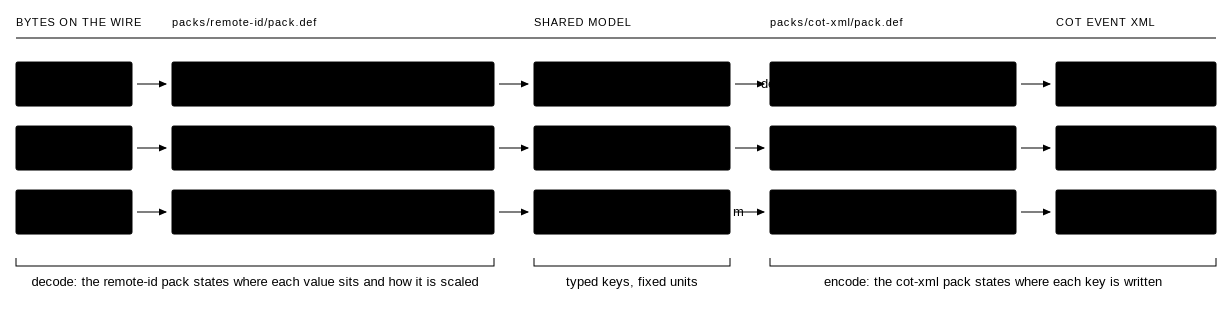
field line of a bits pack gives the word, the first bit and the number of bits, then how to scale the integer. A field line of an xml pack gives a path. Neither pack knows the other exists.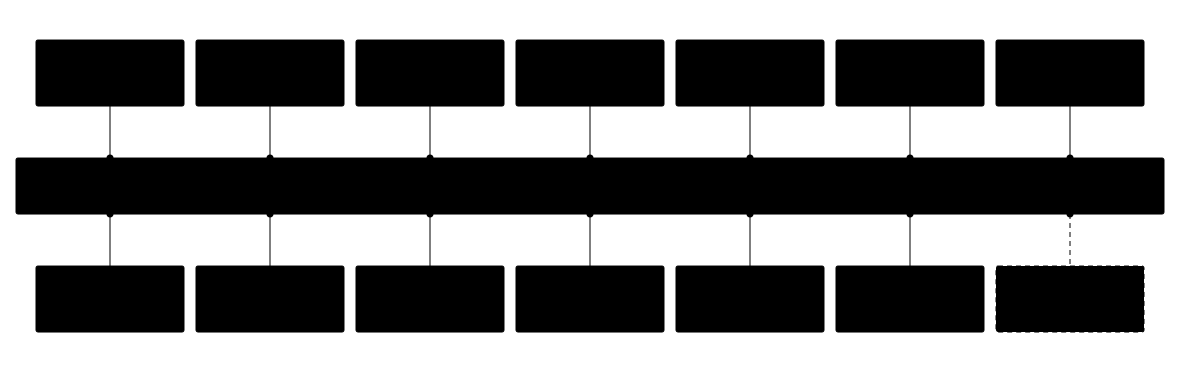
Measured
Checked against hand-written encoders
Projects with their own conversion code run the library beside it, chosen by a setting that defaults to their own code. Each project's tests compare the two paths on its own inputs, field by field, and fail when the result moves.
| Compared with | Conversion | Inputs | Result |
|---|---|---|---|
| open-billie, Rust encoder | Canonical Track v2 to ASTERIX Category 062 | 33 tracks, 25 encoded by both | bytes identical on all 25 397 of 397 fields equal |
| open-billie, Rust encoder | Canonical Track v2 to Cursor on Target | 33 tracks | 17 of 33 byte-identical 547 of 594 fields equal |
| open-billie, Rust encoder | Canonical Track v2 to SAPIENT | 33 tracks | 579 of 717 fields equal |
| first-bite, dictionary decoder | decode its fixture messages | 42 messages | 42 of 42 same message type 443 of 462 fields equal |
| first-bite, its CoT writer | weather-station Position records to Cursor on Target | 502 records | version, uid, type,how, ce, le equal on 502 of 502 |
| goatstuff, goat-map's CoT reader | Cursor on Target to GeoTrackV1 | 26 events, 16 accepted by both | 353 of 368 members equal 15 the same number in another form |
open-billie and first-bite measured in their CI at library commit 0be9fc9. For ASTERIX the caller supplies the two site codes. docs/consumer-proofs.md lists each project, every difference that remains, how many inputs it affects and what would close it.
Ten lines
Add a format without writing code
This is the complete pack for a NATO Vector Graphics point, beside the message it describes.
format   nvg
version  0.1.0
distribution public
source  "NATO Vector Graphics 1.5 XSD (NATO ACT, public)"
wire     xml
root     nvg
field   lon       point/@x        float
field   lat       point/@y        float
field   callsign  point/@label    string
field   type      point/@symbol   string
<nvg><point x="11.2" y="48.137" label="ALPHA" symbol="app6a:SFGPUCI----D"/></nvg>
$ goat-xf convert --from nvg --to geojson < point.xml
{"type":"Feature","geometry":{"type":"Point","coordinates":[11.2,48.137]},"properties":{"type":"app6a:SFGPUCI----D","callsign":"ALPHA"}}
Each field line reads: the model key, the place in the message, the transform. The pack language also states binary layouts by bit range, scale factors, several message kinds chosen by values in the message, constants, defaults, value tables and repeating groups; the grammar is spec/engine-spec.md. A pack for a large message catalog is generated from the catalog's own machine-readable definition by the generators in tools/gen.
Packaging
Make exactly what you need
Seven languages
A native library in Rust, Go, Python, Java, C++, Erlang and Zig, each with no dependency beyond its standard library. For other hosts, the Rust engine is also a C library and a WebAssembly module with a JavaScript wrapper and TypeScript types.
Runtimes
The Rust and Go engines build to one fully static binary and to WebAssembly. The Java engine is a jar. The Python and Erlang engines ship with their runtime. docs/package-configurator.md has the table of build targets.
Only the packs you name
A pack loads on its own, so a deployment carries only the formats it uses.
$ goat-xf list-formats --packs-only remote-id,cot-xml
cot-xml
remote-id
On a narrow screen the output scrolls sideways.
The planner
tools/goat-pkg plan takes the formats, the language and the runtime and prints the smallest package.
$ tools/goat-pkg plan --formats remote-id,cot-xml --language rust --runtime wasm
engine:      engines/rust
packs:       remote-id, cot-xml   (only these)
wires used:  bits, xml   (a minimal engine build can exclude the rest)
build:       cargo build --release --lib --target wasm32-unknown-unknown
To choose which formats a deployment needs, tools/goat-options lists every way data can get from a system that produces it to a system that needs it, from plain-text system records and the packs, with the status of each step (docs/system-records.md).
| What | Bytes | Measured with |
|---|---|---|
| WebAssembly module, small build | 786,657 | footnote 4 |
The same module after gzip -9 | 235,164 | gzip -9 -c goat_transformers_wasm.wasm | wc -c |
Command-line tool goat-xf, release build, macOS arm64 | 1,657,776 | wc -c engines/rust/target/release/goat-xf |
| The two packs of the conversion at the top of this page | 8,712 | cat packs/remote-id/pack.def packs/cot-xml/pack.def | wc -c |
| The three model modules those packs use | 13,014 | cat model/core.def model/rid.def model/track.def | wc -c |
Why open
One definition of each format, in the open
A correction reaches every user
There is one definition of each format. A gap or an error in a pack is corrected in one file, and every user of that format, in every language, has the correction at the next update.
The owner of a format can keep its pack
A pack is a text file that mirrors the format's specification. The organization that writes the specification can maintain the pack directly, by pull request.
Nothing about a format is inside a product
Field positions, units and rules are readable text with a named source. The engines are Apache-2.0 and use only standard libraries.
A new format reaches every language at once
One pack makes a format convertible to and from every format already present, in all seven languages, in a browser and in a static binary.
Private formats
A format whose specification is not public stays private
A pack for such a format is kept in a private overlay repository, which names the commit of this repository it builds with and adds its own packs; the same engines read both, and the format converts to and from every public format through the shared model. Every pack is marked distribution public or distribution controlled, and an engine started with --max-distribution public loads nothing marked controlled.
docs/boundary.md states the rules and the checks. goat-transformers-overlay-example is a worked overlay with fictional content.
Install
Use it from the repository
There is no package in a registry. Clone the repository and use the engine for your language; each one builds and tests with the command shown.
| Your code is in | Use | Build and run every vector |
|---|---|---|
| Rust | engines/rust, the reference engine and goat-xf | cargo test --release |
| Go | engines/go | go test ./... |
| Python | engines/python | PYTHONPATH=src python3 -m unittest discover -s tests |
| Java | engines/java | ./build.sh |
| C++ | engines/cpp | cmake -S . -B build && cmake --build build && ctest --test-dir build |
| Erlang | engines/erlang | ./build.sh && ./run_tests |
| Zig 0.13 | engines/zig | zig build test |
| JavaScript or TypeScript, in Node or a browser | bindings/wasm, the module this page runs | node --test bindings/wasm/test/vectors.test.mjs |
| C, or a language that can call C | bindings/c | cd bindings/c && ./test.sh |
Each command runs from the directory in its row; the two bindings commands run as written from the repository root, the WebAssembly one after the module is built. bindings/README.md shows the calls of the C library and the WebAssembly module. CONTRIBUTING.md states how to add a pack, a wire type or an engine. The library is pre-1.0: the pack language and the engine interfaces can still change.
Under the hood
The shared model
Every format in this library converts through one common set of typed values: the shared model. This section says what it is, why the library is built on it, what it guarantees, and how it is kept safe. The full definition is spec/shared-model.md.
What it is
A conversion is two steps: decode the source message into keys of the model, then encode those keys into the target format. No format is converted to another directly.
| Part | What it holds | Defined in |
|---|---|---|
core | what any position report means, in fixed units: identifier, type, time, latitude and longitude (WGS 84), height above the ellipsoid, horizontal and vertical error, course, speed, name. These are the fields of a Cursor on Target event. | model/core.def |
track | facts about a sensor track: its source, velocity vector, class, confidence, uncertainty and status flags. These follow the Canonical Track v2 contract field for field. | model/track.def |
| one module per format | every other field of that format, under its own name, so that nothing is lost when a message goes back to its own format | model/<module>.def |
Units are fixed by the model, not by a format: degrees, meters, meters per second, milliseconds since 1970 (UTC). Each format's pack converts its own units on the way in and on the way out.
Why a shared model
| Approach | Work for N formats | A new format needs |
|---|---|---|
| A converter for each pair of formats | N × (N − 1) converters | a converter to and from every existing format |
| One shared model (this library) | N packs | one pack |
The same pattern carries other wide conversion tools: pandoc converts documents through one document model, and GDAL converts geographic data through one data model.
The library does not use an existing message standard as the hub. Each candidate covers one domain (air traffic, land tactical data, maritime, space telemetry) and leaves the others out, several are heavy to implement, and some are not public. The shared model reuses existing definitions where they fit instead of inventing new ones: core is the Cursor on Target event, and track is the Canonical Track v2 contract.
What it guarantees, and what it does not
| Conversion | What happens |
|---|---|
| A format to itself | Nothing is lost. A field the model has no key for is kept with the message and written back, so the message returns in its canonical form. Round-trip conformance vectors pin this. |
| One format to another | Exactly the values that both formats map carry. The capability report (goat-xf capability --from A --to B, or goat-xf matrix) lists what carries and what is dropped, from the two packs alone, before any message is converted. |
| A pair that must lose nothing | Not guaranteed by the model. A direct rule for that pair is planned (spec version 0.53). |
Cross-format loss is listed by the capability report but not yet reported per message. A per-conversion loss report, and a strict mode that refuses a conversion that would drop a field the caller requires, are being added.
How it is kept safe
| Risk | Safeguard |
|---|---|
| A key changes meaning under its users | Keys are never renamed and never change type. A new meaning is a new key. |
| A pack writes a value of the wrong type | Every engine checks each pack against the model when it loads, and refuses a mismatch. |
| One implementation reads the model differently | Seven engines, written independently from the specification, must give the same bytes on every conformance vector. |
| All engines agree on a wrong value | Values are compared with the projects' own encoders and decoders on their own inputs (docs/consumer-proofs.md). Every conversion vector's decoded values are checked against a plausible range or set for their key (latitude, longitude, height, errors, course, speed, times, confidence, class, flags), and every pack that maps a height must name its vertical datum (tools/model-checks.py, rules in tools/model-ranges.json). Checks against each format's reference implementation are being added. |
| A change to the model breaks a user | Each project pins a library commit, so a change reaches no one until they move. A change to core or track needs a written decision record (docs/adr/) and is measured against every known user before it merges. |
Time quality
Time quality travels with every report, on two independent axes. A pack never invents it: each key is absent unless the source message states it.
| Axis | Keys | Status |
|---|---|---|
| Coherence of the clock that stamped the report | time_error_ms (the error bound), time_state (coherent, drifting or free-running) | in core |
| Confidence in UTC, and a signed attestation of time quality | the UTC state, its error bound, the anchor and the age of the last anchor; an attestation reference | being added |
A clock can be coherent while its relation to UTC is unknown. That is a normal, healthy state, and with the second axis the model can state it.