>_ billie verify
open-billie
Any sensor in, one track record, three standard formats out.
Open Billie prepares a node, builds a small package for each sensor (a kid), and publishes its data, normalized, as CoT, ASTERIX CAT062 or SAPIENT through Zenoh. The kid decodes; the shared translator writes the format.
$ git clone https://github.com/USAREUR-AF/open-billie
$ cd open-billie && bash tools/setup.sh
The guided workflow, from Linux or macOS; on Windows, tools\setup.ps1. It installs to an Ubuntu Server 24.04 node over SSH.
1 · sensor bytes in110 bytes
Real data, replayed: a conformance vector of the synthetic OETF example, decoded and mapped by the example kid and encoded by the real Rust translator. Made by site/hero-data/make.py.
the OETF vector, hero-data.jsonCAT062: 31 B; same fileenum EncoderFormat, request.rsContainerfile* in kids/examples/oetfWhat it is
A sensor-neutral project for preparing a node, building sensor-specific kid packages, and publishing normalized data through the shared Billie translator and Zenoh path. The node runs Billie locally after installation. Proprietary sensor protocols, decoders, mappings and captures stay outside this repository; the example kid and the sensor simulator use synthetic data.
One guided install
The wizard checks the release, the node's architecture, SSH access and prerequisites, then installs the platform on Ubuntu Server 24.04, amd64 or arm64. The platform owns local Zenoh, fabric mTLS, routes and the bridge.
A package per sensor
A decoder, a schema, a user-defined mapping and lookups, synthetic conformance vectors and a runtime adapter. A kid needs no fabric credentials and no encoder of its own.
Standard formats out
The shared Rust translator turns the canonical track into CoT XML, an ASTERIX CAT062 Edition 1.21 record, or a SAPIENT BSI Flex 335 v2.0 message, and rejects anything outside the versioned contract.
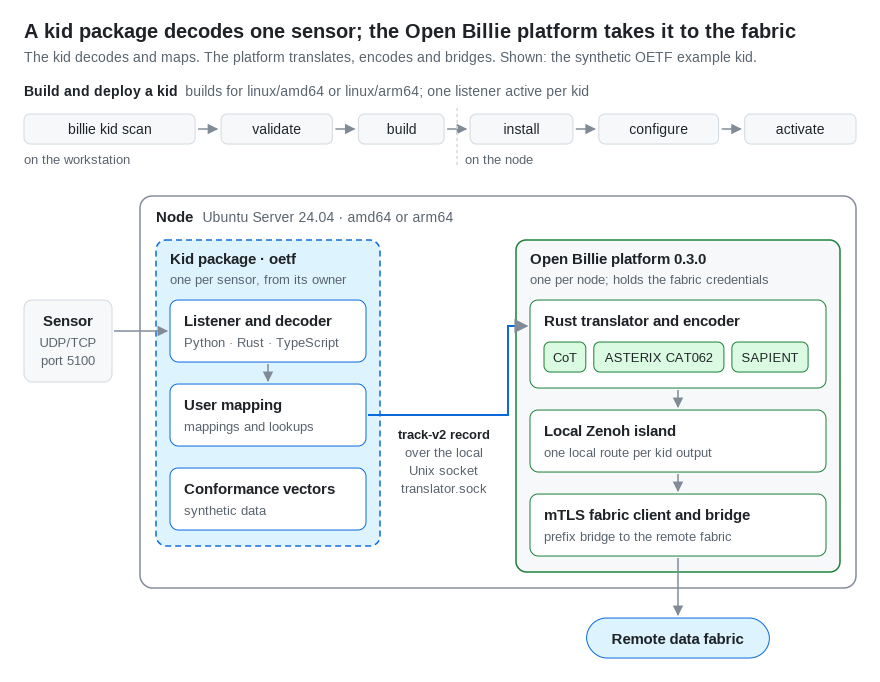
docs/figures/: the boundary between a kid and the platform on one node.Where the line is drawn
The kid owns the sensor: its wire format, its decoder, and the mapping from its fields to Billie's canonical record. The platform owns everything that touches the network beyond the node. The record crosses between them over a local Unix socket.
Sensor TCP/UDP input
  -> kid decoder and user mapping
  -> canonical record over local Unix socket
  -> shared Rust translator and encoder
  -> local Zenoh route
  -> Open Billie platform mTLS bridge and remote fabric
Contracts: decoder to translator, canonical track v2, Zenoh and fabric security.
Build and deploy a kid
The local tools scan and validate kid sources, build a package for linux/amd64 or linux/arm64 with Docker or Podman, and ask which decoder implementation to use when there is more than one. The guided deployment transfers and installs it, lets you choose a declared TCP or UDP listener, and activates it.
| Step | Command |
|---|---|
| validate | bash deploy/bin/billie kid validate kids/examples/oetf |
| build | bash deploy/bin/billie kid build kids/examples/oetf --platform linux/arm64 |
| install | sudo billie kid install /tmp/billie-kid-oetf_0.1.4.tar.gz |
| configure | sudo billie kid configure oetf --transport udp --bind-address 192.0.2.20 --port 5100 --source-cidr 192.0.2.0/24 |
| activate | sudo billie kid activate oetf |
Kid bundles are separate from the platform release and are unsigned; their checksums detect file changes but do not authenticate the builder. Start with the kid package authoring guide and the template.
The real validator, on the example kid
$ bash deploy/bin/billie kid validate kids/examples/oetf
Valid kid source: oetf@0.2.0
Manifest: open-billie/kids/examples/oetf/billie-kid.yaml
  decoder: packages/oetf/python/src/billie_oetf/decoder.py
  mapper: packages/oetf/python/src/billie_oetf/mapper.py
  schemas: packages/oetf/shared/schemas
  mappings: packages/oetf/shared/mappings
  lookups: packages/oetf/shared/lookups
  vectors: packages/oetf/shared/conformance/vectors
WARNING: runtime.image is a development placeholder and is not deployable
Source structure is valid; resolve warnings before treating it as deployable.
Recorded by site/captures/capture-validate.sh. The warning is the validator doing its job: the example's image is a placeholder until a build fills it in.
Start here
Read the provisioning guide before installing: prerequisites, credential inputs, wizard prompts and troubleshooting. The target node is Ubuntu Server 24.04, amd64 or arm64, with SSH access and non-interactive sudo.
| From | Run |
|---|---|
| Linux | bash tools/setup.sh at the repository root |
| macOS | bash tools/setup.sh; builds run in a Docker or Podman Linux container |
| Windows 10/11 | tools\setup.ps1 from PowerShell; runs Bash in Ubuntu 24.04 on WSL 2 |
Take it off again
Remove a kid and keep the platform, or remove the platform. Teardown lists what it will remove, asks for confirmation, and asks a second time before deleting node identity and fabric credentials. NetBird is left untouched.
$ sudo billie kid deactivate <id>
$ sudo billie kid remove <id>
$ sudo billie teardown
Before updating a node, read the upgrade notes: platform 0.3.0 requires kids built for the v2 canonical track contract. Validation status and open items: testing log.