>_ goat-client status
goat-client
One signed file, and the device is on the goat network.
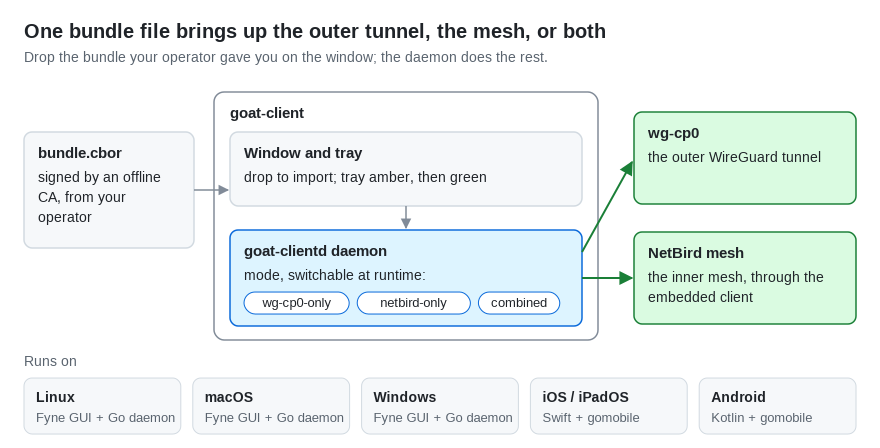
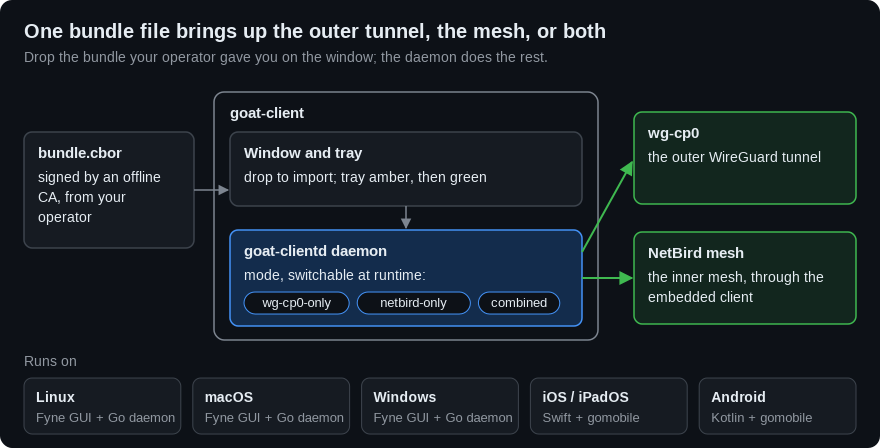
A daemon, a desktop GUI and a command line for Linux, macOS and Windows, with iOS, iPadOS and Android shells. It takes a bundle signed by an offline certificate authority, checks the signature, and brings up the outer WireGuard tunnel, the inner NetBird mesh, or both.
$ git clone https://github.com/USAREUR-AF/goat-client && cd goat-client
$ go build -o bin/ ./cmd/goat-client ./cmd/goat-clientd
Needs Go (the version in go.mod); the GUI also needs cgo and the platform's graphics libraries. No release is published yet.
Two real recordings, replayed: the daemon and CLI run unprivileged with a throwaway signing key (capture-cli.sh), then the hermetic real-protocol test that completes a WireGuard handshake in one process (capture-handshake.sh).
cli-session.txtreal-protocol test, handshake.txtgui matrix, release.ymlusage text, cmd/goat-clientWhat it is
goat-client replaces the command-line enrollment ceremony with an app. An operator mints one bundle per device with bundle-create from goatcore; the person on the device drops it on the window, or a headless box imports it from the shell. The daemon verifies it against the pinned offline-CA root, keeps it, and brings the tunnels up.
One CBOR file, signed offline
Issued-to, site, validity window, the peer's WireGuard key and endpoints, signed with ECDSA P-256 by an offline CA. Hand it over by file, USB, or a QR code for an air-gapped device.
goat-clientd
A system service that holds the bundle, brings up and keeps the tunnels, and serves a local IPC socket. The packages register it to start on boot.
GUI and CLI, one binary
goat-client with no arguments is the tray app and window; with a subcommand it is a CLI for headless boxes and scripts. Everything the GUI does, the CLI can do.
docs/figures/.Three modes, one process
The mode is chosen at install and can be switched at runtime with goat-client setmode.
| Mode | Brings up |
|---|---|
wg-cp0-only | the outer WireGuard tunnel alone |
netbird-only | the inner mesh alone, through the embedded NetBird client from USAREUR-AF/netbird |
combined | both tunnels in one process |
Linux, macOS and Windows on amd64 and arm64 get the Fyne desktop GUI and the Go daemon. iOS and iPadOS get a gomobile daemon framework in a Swift NEPacketTunnelProvider shell; Android a gomobile AAR in a Kotlin VpnService shell.
The CLI
The same binary as the GUI. It talks to the daemon over the local IPC socket and exits. On a headless box, import the bundle with the daemon's one-shot mode, then drive it from the shell.
$ sudo goat-clientd --import-bundle alice-bundle.cbor
$ goat-client status       # mode, state, bundle, counters
$ goat-client connect      # idempotent
$ goat-client disconnect
$ goat-client getmode
$ goat-client setmode combined
Subcommands, output fields and exit codes: docs/cli.md. When something does not come up: troubleshooting.
An unsigned bundle does not get in
The daemon checks every bundle against the pinned trust roots before it keeps it. In the recording above, one changed byte in the site name is enough: signature does not match any trust root, exit 1, nothing persisted. The release workflow signs every asset too, with cosign, keyless, under its own GitHub identity; the README shows the cosign verify-blob command.
A public build trusts the system roots only and pins no bundle-signing key. A deployment adds its CA root to internal/ipc/grpc/trust/ and its bundle-signing keys to internal/trustanchor/anchors.yaml before building.
Build it
The release workflow builds .deb, .rpm, .dmg and .msi packages for each tagged release; none is published yet, so build from source.
$ git clone https://github.com/USAREUR-AF/goat-client
$ cd goat-client
$ go build -o bin/ ./cmd/goat-client ./cmd/goat-clientd
Cross-compile to any of the six desktop targets with GOOS and GOARCH; the GUI needs CGO_ENABLED=1 and each platform's graphics libraries, the daemon alone builds with CGO_ENABLED=0. iOS and Android builds: README, Build from source.
First run
The daemon starts with no bundle and waits. Give it one either way:
| How | What happens |
|---|---|
| In the GUI | Drop bundle.cbor on the window. It shows issued-to, site, expiry, peer key and endpoints from the file; Apply hands it to the daemon. The tray icon turns amber while the tunnel comes up, then green. |
| By hand | Put it at /var/lib/goat-client/bundle.cbor (Linux), /Library/Application Support/goat-client/ (macOS) or %ProgramData%\goat-client\ (Windows), and restart the daemon. |
Operator to device, end to end: docs/quickstart.md.